Network History
Cleveland Free-Net: Where Public Internet Began
From a medical Q&A board to tens of thousands of users: the story of the Cleveland Free-Net, the first community network.
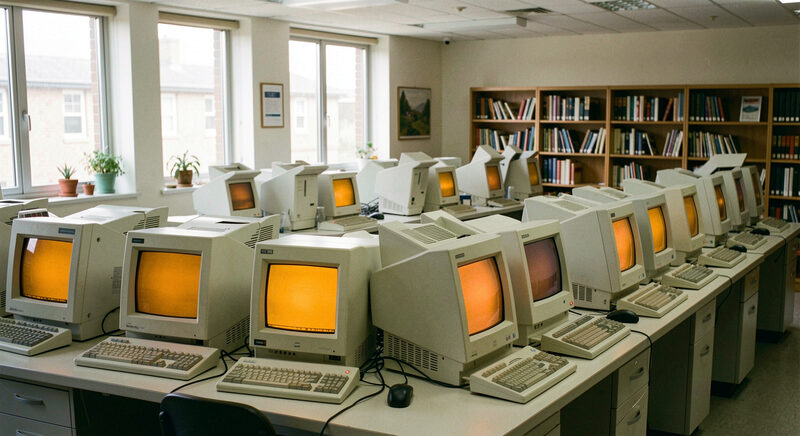
Every community network has a creation story, and the movement's starts in Cleveland. The Cleveland Free-Net, which began public operation in July 1986, is generally recognized as the first community computer system of its kind: a free, public-access network open to any resident with a terminal and a phone line. Its history is the template the rest of the free-net era was built on.
From a medical question board
The system grew out of a smaller experiment at Case Western Reserve University. In 1984, Dr. Tom Grundner and colleagues at the School of Medicine set up a bulletin board called St. Silicon's Hospital and Information Dispensary, which let the public post medical questions that physicians answered free of charge. The idea had an earlier seed still: an Apple II+ and a 300 baud modem used to field questions from medical students spread across Cleveland hospitals.
The public response made the larger point. Ordinary people had questions, a computer and a modem could carry them, and no one needed to charge admission. Grundner expanded the hospital into a virtual city, and the Cleveland Free-Net opened its doors.
What the system offered
The Free-Net presented itself as a set of buildings rather than menus of files. Users moved through a post office for email, a schoolhouse, a courthouse, a hospital and other departments that held community information, discussion areas and services. Case Western Reserve provided the institutional home; Ohio Bell and AT&T contributed money and equipment.
Adoption was fast. The system reached a thousand registered users within two years, and after a 1989 reorganization that added full internet access, registrations surged again. Histories of the system record that by 1992 the Cleveland Free-Net had well over 40,000 registered users and was handling more than 10,000 logins a day, supported by more than 250 volunteer system operators.
FreePort: the model in a box
What turned a Cleveland experiment into a movement was software. The system ran on a package called FreePort, developed at Case Western Reserve, which other institutions could license for a nominal fee of one dollar. Dozens did. Free-nets appeared across the United States and abroad, each locally governed, each shaped by its own community.
To coordinate the spread, Grundner founded the National Public Telecomputing Network in 1989. NPTN held the Free-Net trademark and distributed FreePort to affiliates, a story told in the NPTN and FreePort guide. The Cleveland system remained the reference implementation and the proof that the model could scale.
What did users actually do there?
The use cases look modest now and were significant then. Residents sent their first email, joined special interest groups, read health columns, checked the community calendar and asked professionals questions they could not have asked otherwise. Local organizations published information to an audience that had no other way to reach it. For many Clevelanders, the Free-Net was not a step toward the internet; for years, it simply was the internet.
The people the system depended on
The Free-Net's staffing model deserves its own note because every later community network inherited it. The system's daily life ran on volunteers: hundreds of them moderated discussion areas, kept information fresh, answered user questions and recruited the organizations that became information providers. Paid staff existed but stayed thin, which is what made free accounts possible. The arrangement also made the system dependent on a steady supply of civic energy, and the volunteer pipeline was as critical to survival as the modem pool.
The long decline and the 1999 shutdown
The conditions that created the Free-Net also contained its end. Commercial internet providers multiplied through the 1990s, offering graphical web access the text-based system could not match. Registrations fell for the first time in the mid-1990s. In mid-1999 the university decided to discontinue the service, citing Y2K compliance problems, and on September 30, 1999, the Cleveland Free-Net closed.
Former users have long disputed whether Y2K was the real reason or a convenient one. What is not disputed is the institutional lesson: a service carried by one university's budget was always one budget away from the end.
What Cleveland proved
The system's deepest contribution was conceptual. It demonstrated that the public would come, that the demand for networked information was mass-market rather than specialist, years before commercial providers proved the same thing for a subscription fee. It demonstrated that volunteers could run real infrastructure, not just forums. And it demonstrated that a university, a phone company and a city's civic groups could share one project, an alliance every later community build has tried to reassemble, with varying success.
Why it still matters
The Cleveland Free-Net established the pattern that later systems, including the Greater Houston Free-Net, repeated: a civic mission, volunteer labor, institutional sponsorship and free accounts for residents. It also established the movement's recurring vulnerability, dependence on a small number of sponsors. Anyone weighing a community network today will recognize both halves of that inheritance. The fullest short account is the Encyclopedia of Cleveland History entry on the Cleveland Free-Net at Case Western Reserve University.
Standing in 2026, the Cleveland Free-Net reads less like a relic than a rehearsal. The homework gap, the library computer row, the municipal fiber debate, the neighborhood mesh install: each is a scene the Free-Net played first, at 2400 baud, on borrowed machines.