Community Builds
Neighborhood Mesh Networks in Practice
How mesh networks share connections rooftop to rooftop, where they work best, and what a small mesh build involves.
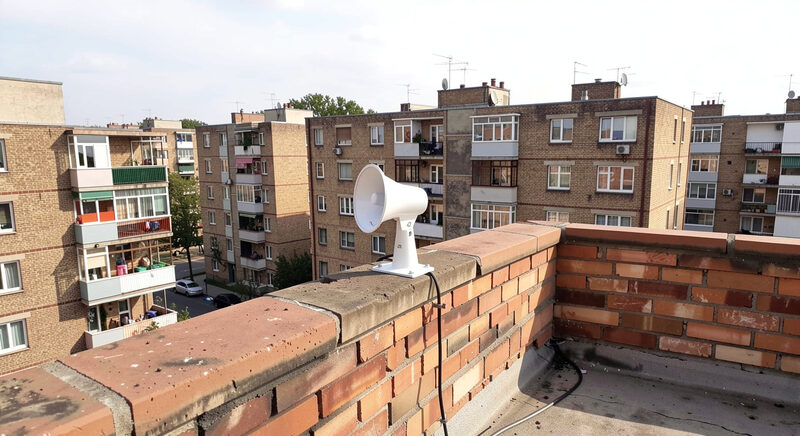
A mesh network is the smallest viable form of community broadband: a set of nodes, usually radios on rooftops and windowsills, that pass internet traffic from one to the next until it reaches a wired connection. No central office, no neighborhood-wide build, just neighbors sharing a route to the wider network. Done well it is cheap and resilient; done casually it is neither, and the difference is mostly planning.
A network made of neighbors
The unit of a mesh is the node: a small radio, typically an outdoor directional antenna or an indoor router, installed at a member's home. Each node talks to whichever neighbors it can reach, and traffic hops node to node until it finds a path out. There is no single point of failure because any reachable neighbor will do; that redundancy is the mesh's structural advantage.
The practical consequence is that a mesh grows by adjacency. A new member joins by reaching an existing node, which makes the first nodes' placement the decision that shapes everything after.
Nodes, hops and line of sight
The physics is simple and unforgiving. Wireless links work best with clear line of sight between antennas, and each hop costs some throughput, so a mesh design minimizes hops and favors rooftops over windowsills. Trees, hills and tall buildings are the enemies; a leaf-filled canopy can break a link that worked all winter.
Distance per link ranges from a few hundred feet to a few miles depending on equipment and band. Long links need directional antennas pointed carefully; short links can use cheaper omnidirectional gear.
Where the internet enters
A mesh does not create internet; it shares it. At least one node needs a backhaul connection, a wired or high-capacity wireless link to a provider, sometimes called a supernode or gateway. Large volunteer meshes maintain several, funded by member contributions. The backhaul's capacity and cost set the ceiling for the whole mesh, which is why established projects treat gateway sites as shared infrastructure.
What does it cost in practice?
Community meshes run on a volunteer-and-donation model. NYC Mesh, the largest volunteer mesh in the United States, asks new members for a contribution toward the rooftop install and a suggested monthly donation, with volunteer labor doing the work. Equipment for a single node runs from under a hundred dollars for a short-range link to several hundred for a directional rooftop install, plus the installer's time.
The hidden cost is maintenance. Nodes weather, roofs get reroofed, members move. A healthy mesh budgets volunteer hours, not just hardware, and the projects that last are the ones that treat installs as a standing activity rather than a one-time event.
Where mesh works, and where it does not
Density is the friend. Apartment blocks and rowhouses give a mesh many potential nodes per square block and short hops between them, which is why volunteer meshes have flourished in dense cities. Spread-out suburbs and hilly or heavily wooded terrain make each link longer and rarer, and a mesh there may serve a few clusters rather than a whole neighborhood.
Two quieter constraints matter as much as geography. Roof access is political: a landlord or co-op board that refuses an antenna kills a node no radio can replace, which is why established meshes keep written agreements with building owners. And skills concentrate: if only one volunteer understands the routing, their absence is an outage, so documentation and shared installs are maintenance, not overhead.
Mesh and the bigger builds
Mesh and fiber are often presented as rivals, but in practice they answer different questions. Fiber delivers capacity and longevity at construction prices; mesh delivers reach at volunteer prices. The documented pattern is complementarity: a mesh brings connectivity now to a block that a wired build might reach in years, and a municipal or co-op backbone can later supply the mesh's gateways. Treating the two as stages of the same project is how the more experienced community networks frame it.
Could your block run one?
A block-scale mesh is a reasonable volunteer project if three conditions hold: a handful of households within sight of each other want in, at least one has or will buy a solid backhaul connection, and someone will learn the radios well enough to keep them running. The startup path described in the community network guide applies at this scale too: survey first, pilot on two or three nodes, grow only after the links prove stable. For the wired alternatives a mesh complements rather than replaces, see the community broadband guide. The mechanics and the volunteer ethos descend from the same tradition documented in Network History; NYC Mesh publishes its install guides and maps openly for anyone adapting the model.
Costs and conditions aside, the mesh's real product is governance: a neighborhood that can run a network can also decide what the network is for. That is the trait shared with the free-nets and the trait that makes the model worth learning even where a wired build is coming later.